
The Science Behind Liquid-to-Solid Ratios: What Actually Happens in Your Blender?
Ever wonder why some smoothies turn out silky-smooth while others come out chunky or watery—even when you’re using the same ingredients? The secret lies in one simple factor: your liquid-to-solid ratio. Behind every perfect blend is a bit of food science, and once you understand it, you’ll be able to control texture, thickness, and smoothness with confidence and make good smoothies with your blender
What Your Blender Is Really Doing
When your blender starts spinning, three things happen:
1. A Vortex Forms
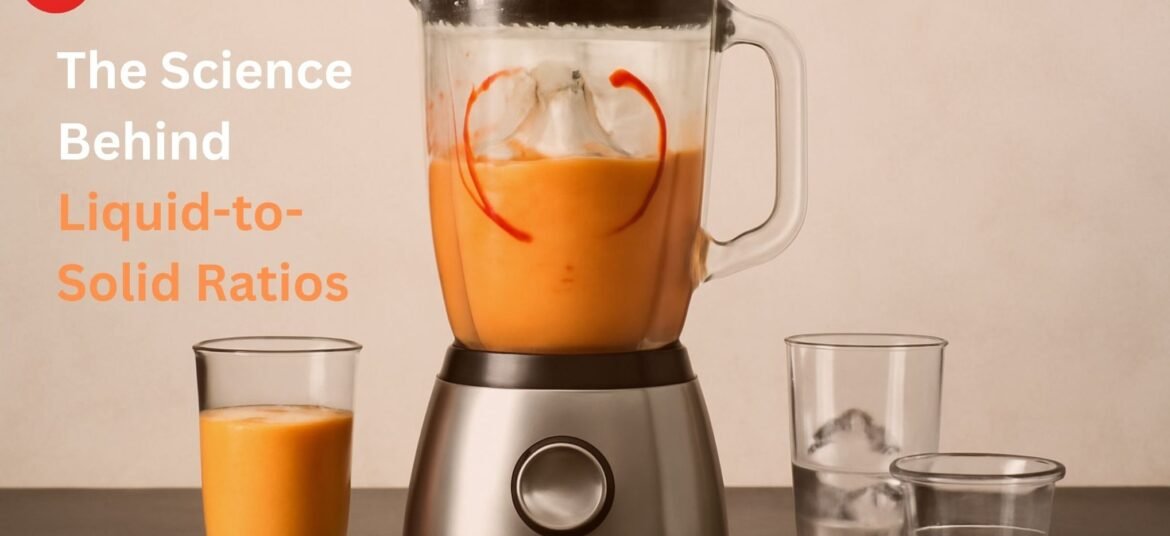
The blades pull ingredients downward into a swirling funnel. This vortex is essential—it keeps the mixture circulating so every chunk gets pulled back into the blades.
2. High Shear Breaks Down Ingredients
Right near the blades, the mixture moves incredibly fast. This speed difference (shear) tears apart fruits, veggies, ice, and nuts into smaller particles.
3. Constant Circulation Creates Smooth Results
If the mixture can move freely through the jar, everything gets blended evenly. If it’s too thick, circulation stops—and the blades spin helplessly beneath a mound of ingredients.
This is why ratios matter: they determine whether your blend flows correctly or clumps.
How Liquid-to-Solid Ratio Affects Texture
Thin Ratios: Easy But Watery
When you use more liquid than solids, the blender forms a vortex easily, giving you a quick, effortless blend. But the final drink may taste weak or thin.
Great for: protein shakes, light fruit drinks.
Balanced Ratios: The “Goldilocks Zone”
A roughly 1:1 ratio of liquid to solids (for example, 1 cup liquid and 1–1.5 cups fruit) hits the sweet spot.
Results:
Creamy, rich texture
Ingredients circulate smoothly
Motor runs efficiently
Perfect for: everyday smoothies and shakes.
Very Thick Ratios: Smoothie Bowl Territory
When solids significantly outweigh liquids, you enter the “too thick” zone.
Common signs:
Blender struggles
Air pockets form
You need a tamper or stop to scrape the sides
Ideal for: smoothie bowls, nice cream, nut butters.
Ingredients Change the Rules
Not all solids behave the same:
Fibre-rich fruits/greens (berries, apple, spinach) create thicker blends.
Fats (avocado, yogurt, nut butter) make smoothies creamier even with less liquid.
Frozen fruit and ice start as solids but slowly melt, loosening the blend over time.
Understanding these interactions helps you adjust on the fly.
How to Find Your Perfect Ratio
Start with this simple guide:
Smoothies: 1 cup liquid + 1–1.5 cups solids
Thicker smoothies: Add more frozen fruit or reduce liquid by ¼ cup
Smoothie bowls: ½–¾ cup liquid + 2–2½ cups frozen solids (use a tamper)
Watch your vortex—if it stops, add a splash more liquid.
Final Sip
Once you understand how liquid-to-solid ratios influence movement, particle size, and thickness, you can customize every blend to taste exactly the way you want.
Your ingredients supply the flavour.
Your blender adds the power.
Your ratio creates the perfect texture.

One Response